

Henslowe writes: ne ... R at harey the vj the 3 of marche 1591 ... iijll xvjs 8dToday, we have the first appearance of William Shakespeare in Henslowe's Diary! Well, sort of. The extent to which Shakespeare was actually involved in Harry VI is unclear, but this entry sheds some interesting light on his early career successes.
In modern English: New. Received at Harry VI, 3rd March 1592 ... £3, 16 shillings and eightpence.
There are a couple of things to say about what Henslowe wrote today. First, notice that he writes "ne" next to the entry. Henslowe will add these letters to a few other plays in the future, and scholars have determined that he probably means "new"; in other words, he's noting the first performance of a new play. Secondly, you can see that London's theatregoers were very excited about this new play called Harry VI, because Henslowe achieved his best box office so far. There are twenty shillings in a pound, so he made 75 shillings today, far more than the 50 he made with The Jew of Malta a few days ago).
What happens in The First Part of Henry VI...
 |
| 1540s portrait of King Henry VI |
England is losing its lands in France to a rebellion. The French army is aided by Joan of Arc (called Joan la Pucelle in the play), who is presented as a sinister, witch-like figure who can conjure devils. But the English have their own weapon of mass destruction: the great warrior Lord Talbot, who triumphs at Orléans and Rouen.
Meanwhile, civil war is brewing in England, emerging out of a quarrel between Richard, Duke of York, and the Duke of Somerset. The two factions show their allegiance by choosing red or white roses from a bush. The tensions undermine Talbot's successes in France when rivalry between York and Somerset causes reinforcements to be delayed and Talbot to be killed in battle at Bordeaux.
 |
| Joan at the stake; detail from Vigiles du roi Charles VII (1484) |
But Suffolk, who has fallen in love with Margaret, is not trustworthy: in the play's last lines, he tells the audience,
Margaret shall now be queen, and rule the king:
But I will rule both her, the king, and realm.
And on this cliffhanger ending, the play seems designed to make us want to see The Second Part of King Henry VI...
Is Harry VI another name for Shakespeare's The First Part of Henry VI?
The evidence for Harry VI being Shakespeare's play is pretty strong. In his 1592 book Piers Penniless's Supplication to the Devil, Thomas Nashe described the popular success of a patriotic play featuring Lord Talbot:
How would it have joyed brave Talbot, the terror of the French, to think that after he had lain two hundred years in his tomb, he should triumph again on the stage and have his bones new-embalmed with the tears of 10,000 spectators at least (at several times), who, in the tragedian that represents his person, imagine they behold him fresh bleeding.
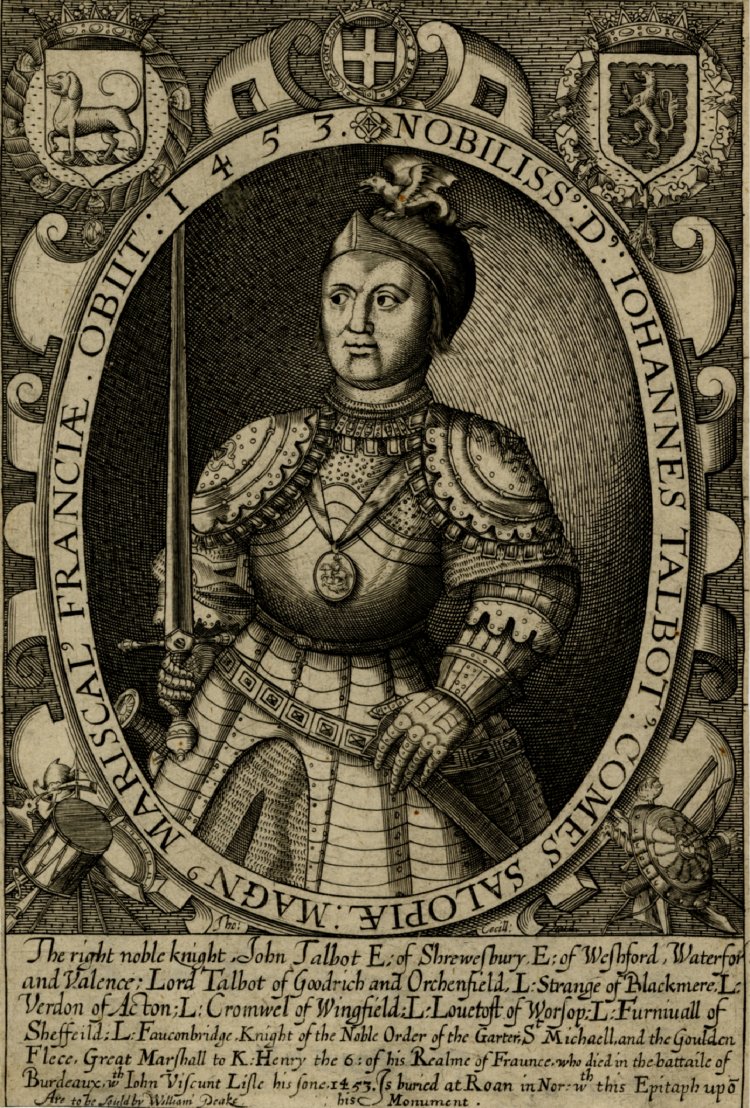 |
| Imaginary portrait of Talbot by Thomas Cecil, c.1626-32 |
That much is clear. More confusing is the play's relationship with the Second and Third parts; here we need to take things more slowly...
What exactly is The First Part of Henry VI?
 |
| The Second Part in the 1623 First Folio |
 |
| The Second Part, published in 1594 as The First Part of the Contention |
3. Another weird thing is that a 1592 book called Greene's Groatsworth of Wit alludes to The Third Part as if it was so well-known that readers were expected to recognize specific lines from it. If The Third Part was already well-known in 1592, why was The First Part described by Henslowe in that year as "new"?
4. Because of all this, the general consensus among scholars is that Part One was written after the other two; it was a 'prequel' about the backstory of the already popular First Part of the Contention and True Tragedy of Richard Duke of York. The plays were then renamed the First, Second and Third parts later.
 |
| Choosing the Red and White Roses by Henry Payne (1908) |
6. But what of Shakespeare? Many modern scholars think Shakespeare didn't actually write much of The First Part (different styles are detectable within it, and collaborative authorship was very common at the time) and there is a complex debate ongoing about exactly how much Shakespeare wrote and who his co-authors were. Does this mean that Strange's Men hired Shakespeare and others to quickly put together a prequel to his own work? Or perhaps Shakespeare had nothing to do with the original Harry VI and what we read today is a version that he reworked once his own company had got hold of it? Again, there are many theories.
If you've read this far and are still interested, I recommend the detailed reassessment of the evidence in Sally-Beth MacLean and Lawrence Manley's book (cited below). However, you may well feel by this point that the play's the thing and you no longer care when it was made and by whom! So, let's look instead at...
The play today
As we have seen, The First Part of Henry VI was extremely popular when it was first performed at the Rose (and would continue to be so for some time); we can speculate that Edward Alleyn was at his barnstorming best as the warrior Talbot, and we could even speculate that the demonic Joan of Arc was an attempt at recycling the fun of the demonic Pope Joan in the play performed two days previously.
For modern audiences and theatre practitioners, however, The First Part is much less appealing, and is rarely staged. It's easy to see why: the plot is episodic, and some of the writing is bland. As a result, The First Part is almost never performed by itself and is seen only on those rare occasions when ambitious theatre companies perform the entire trilogy (or the entire tetralogy including Richard III). If you'd like to look at images from different productions, the Designing Shakespeare website from Royal Holloway University is a great way of doing so. And look out for Kings of War, an upcoming postmodern adaptation by the amazing Toneelgroep Amsterdam.
 |
| Brenda Blethyn as Joan of Arc in the BBC Shakespeare film of The First Part of Henry VI (1981) |
What we learn from this
One thing that the success of Harry VI demonstrates is that Elizabethan audiences liked prequels. We've already seen some possible prequels in Henslowe's Diary: Muly Molocco may have been a prequel to The Battle of Alcazar, and The Spanish Comedy may have been a prequel to The Spanish Tragedy.
Prequels remain popular today, of course, as we, like the Elizabethans, desire to see what happened to the characters we enjoy before they became the characters we enjoy. It's a shame that the most famous modern examples - George Lucas's godawful prequels to the Star Wars trilogy - are as aesthetically problematic as The First Part of Henry VI. But even those films manage to send occasional shivers down the spines of those who love the original works, as our knowledge of what the characters will become colours our experience of watching their formation...
 |
| Margaret of Anjou, illustration from the Talbot Shrewsbury Book 1444-5 |
FURTHER READING
Information on The First Part of Henry VI
- Edward Burns, ed. King Henry VI, Part 1. The Arden Shakespeare (Thomson, 2000), 67-90.
- Michael Taylor, ed. Henry VI, Part One. The Oxford Shakespeare (Oxford University, Press, 2005), 1-14.
- Carol Chillington Rutter and Stuart Hampton-Reeves, Shakespeare in Production: The Henry VI Plays (Manchester University Press, 2009)
- Martin Wiggins, British Drama, 1533-1642: A Catalogue, vol. 3 (Oxford University Press, 2013), entry 919.
- Sally-Beth MacLean and Lawrence Manley, Lord Strange's Men and their Plays (Yale University Press, 2014), 96-99 and chapter 9.
Henslowe links
- Transcript of this page of the Diary (from W.W. Greg's 1904 edition)
- Facsimile of this page of the Diary (from the Henslowe-Alleyn Digitisation Project)
Comments?
Did I make a mistake? Do you have a question? Have you anything to add? Please post a comment below!





0 Yorumlar